

How to Make Your Business Idea Smaller So You Can Actually Start
You have a business idea you love.
Then you start thinking about everything you will need: a website, inventory, equipment, packaging, social media accounts, a logo, insurance, advertising, a perfect product line—and suddenly the idea that once felt exciting feels enormous.
That does not necessarily mean you chose the wrong business.
Sometimes the problem is simply that the first version of your business idea is too big.
Instead of asking, “How do I launch the entire business I have pictured in my head?” try asking:
What is the smallest version of this idea I could realistically start?
Making your business idea smaller does not mean giving up on your bigger vision. It means finding a manageable starting point that lets you learn, test the idea, make your first sales, and decide what deserves more of your time and money.

Why Starting Smaller Can Be a Smart Business Strategy
When we imagine a new business, we tend to picture the finished version.
You may imagine a party rental company with dozens of backdrops, champagne walls, tables, chairs, carts, and photo booths. You might picture an online store with 100 products. Or perhaps you envision a creative studio offering several different services.
But established businesses usually did not begin with everything they eventually offered.
Starting with a smaller version can help you:
Spend less money before you know whether customers are interested.
Learn what customers actually want.
Avoid buying unnecessary supplies or equipment.
Make changes more easily.
Become comfortable selling before expanding.
Discover which part of the business you actually enjoy.
Get started instead of staying stuck in the planning stage.
You aren't shrinking the ultimate goal. You are shrinking the first step.
1. Separate Your Big Vision From Your Starting Point
First, write down what you ultimately want the business to become.
Don't limit yourself here.
For example, perhaps your long-term idea is:
A wedding rental company offering flower walls, champagne walls, selfie stations, décor packages, signs, and mobile dessert carts.
Keep that vision.
Now create a second list called:
What could I offer first?
Maybe the answer is:
One flower wall and three interchangeable signs.
Suddenly, you aren't trying to build an entire rental warehouse. You're testing whether people in your area will pay to rent one specific product.
Your big vision gives you direction.
Your small version gives you somewhere to begin.
2. Find the Core of Your Business Idea
Ask yourself:
What is the simplest thing I could sell that still represents this business?
Imagine removing everything optional from the idea.
If you want to start a gift basket company, you don't need twelve different baskets.
Start with one or two.
If you want to create printable party supplies, you don't need themes for every birthday, holiday, and dog breed.
Create one complete party collection.
If you want to offer event rentals, you don't necessarily need tables, chairs, arches, backdrops, games, carts, and photo booths.
Choose one rental category.
If you want to become a consultant, you don't need five packages, a course, an ebook, and a membership.
Start with one service.
Think of your first offer as a test version of the business rather than the final version.
3. Choose One Customer
Another way business ideas become unnecessarily complicated is by trying to serve everyone.
Imagine someone considering a party business.
Their first list might include:
Children's birthdays
Weddings
Baby showers
Graduation parties
Corporate events
Bridal showers
Holiday parties
Anniversary parties
That creates eight different customer groups before the business even launches.
Instead, choose one.
For example:
I create simple backyard birthday party setups for children ages 3–8.
That one decision makes dozens of other decisions easier.
You know what products to research.
You know what photographs you need.
You know what customers you are trying to reach.
You know what kind of content to create.
You can always expand later.
4. Choose One Product or Service to Lead With
A new business doesn't need a complete catalog.
It needs something people can buy.
Ask:
If I could only offer one thing for the first 30 days, what would I choose?
For an event rental business, it might be a flower wall.
For a printable shop, it might be a birthday party bundle.
For a freelance business, it might be a one-hour consultation.
For a handmade business, it might be one personalized product.
For a pet business, it might be a single type of birthday decoration.
This becomes your starter offer.
Once people begin purchasing or asking questions, you'll have much better information about what to create next.
5. Reduce the Number of Choices
More choices can feel like a better business.
They can also make a new business considerably more expensive and complicated.
Suppose you want to sell personalized tumblers.
Your original plan might include:
10 tumbler colors
20 designs
five fonts
four personalization options
three sizes
That is a lot to manage before you've made your first sale.
A smaller launch might offer:
two tumbler colors
five designs
two fonts
one size
If customers begin asking for additional options, you can add them.
Let demand help build your product line instead of trying to predict everything customers could possibly want.
6. Look for the Expensive Parts of Your Idea
Make a list of everything you think you need to start.
Next to each item, write an estimated cost.
Now circle the expensive items.
Ask yourself:
Do I truly need this before making my first sale?
You may discover that some expenses can be postponed.
Instead of renting commercial space, could you start from home?
Instead of purchasing ten rental pieces, could you begin with two?
Instead of ordering 100 units of a product, could you use print-on-demand or take preorders?
Instead of paying for several software subscriptions, could you use free versions initially?
Instead of hiring someone to create an elaborate website, could you start with a simple storefront?
The goal isn't to avoid investing in your business forever.
It's to avoid investing heavily before you know which parts of the business deserve that investment.
7. Turn a Product Business Into a Service First
This is an especially useful strategy when the product version of your idea requires a significant investment.
Suppose you eventually want to sell party décor.
You might begin by offering a party decorating service using a smaller collection of reusable pieces.
If you eventually want to create a course, you might first offer one-on-one consulting.
If you eventually want to sell craft kits, you might first teach a small workshop.
Services often require less inventory and can help fund the next stage of a business.
They can also teach you what customers struggle with, what questions they ask, and what they are willing to pay for.
8. Create a Minimum Viable Version of Your Idea
You may hear entrepreneurs talk about an MVP, or minimum viable product.
You can use the same concept even if you aren't building a technology company.
Think of it simply as:
The smallest version of my offer that is useful enough for someone to pay for.
For example:
Big Business Idea | Smaller Starting Version |
Full wedding rental company | One specialty backdrop |
Online party store | One downloadable party kit |
Subscription box company | One limited-edition box |
Home décor brand | Five coordinated designs |
Business coaching program | One 60-minute strategy session |
Craft studio | One monthly workshop |
Mobile dessert company | One signature dessert cart |
Pet party company | One birthday theme |
Digital planner company | One planner |
Photography business | One specialized mini-session |
Notice that none of these smaller versions prevents the business from growing.
They simply give it a realistic beginning.
9. Use a Business Idea Scorecard
If you have several possible versions of your idea, don't rely entirely on excitement.
Compare them.
Consider factors such as:
Startup cost
Difficulty
Time required
Customer demand
Profit potential
Competition
Your existing skills
How much you actually want to do the work
Use my Business Idea Scorecard to compare your options side by side.
You might discover that the simplest version of your idea is also the one with the best combination of affordability, interest, and realistic startup requirements.
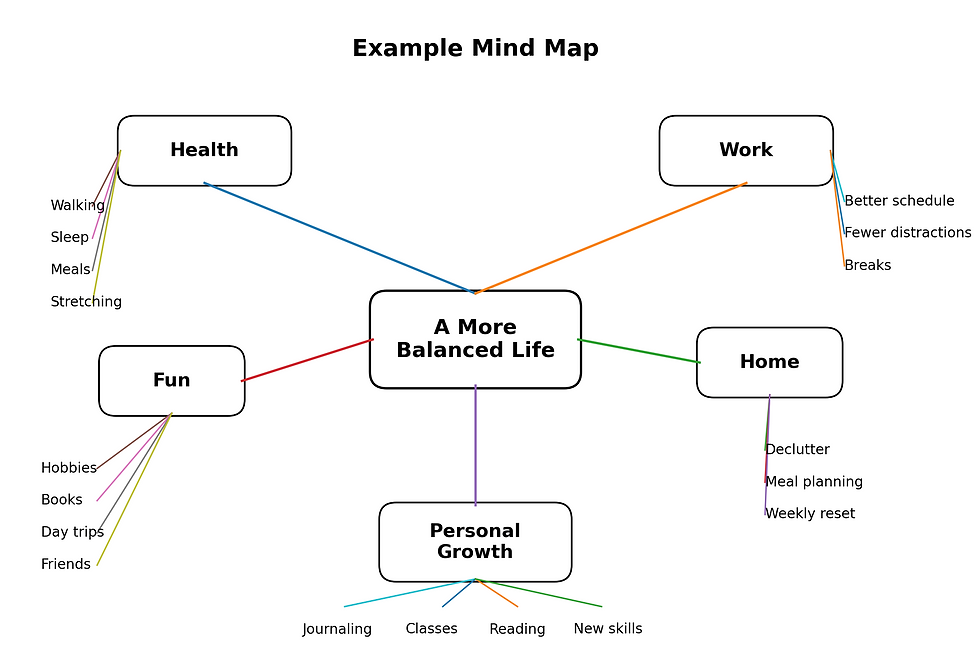
10. Use Mind Mapping to Shrink a Complicated Idea
Sometimes a business feels overwhelming because all of the pieces are floating around in your head at once.
This is where mind mapping can help.
Write your main business idea in the center of a page.
Then create branches for things such as:
Products
Customers
Marketing
Equipment
Startup costs
Sales channels
Future ideas
Once everything is visible, look for what could be removed from your initial launch.
My guide to Mind Mapping for Beginners walks you through the process if you've never created one before.

You may find that your enormous business idea is really several smaller business ideas grouped together—and you only need to start with one of them.
11. Ask What You Can Add Later
Instead of asking:
What does my business need?
Try asking:
What can wait?
Create two columns.
I Need This to Start
These are things required to make and sell your first offer.
I Can Add This Later
This might include:
More products
More colors
Additional services
Premium packaging
Better equipment
Paid advertising
A larger website
Custom photography
Additional social platforms
Employees
Office or retail space
Your "later" list is important.
It gives you permission to keep those ideas without making them requirements for starting.
12. Give Yourself a Small Test Period
Instead of deciding whether you want to operate this business for the next ten years, give yourself a shorter experiment.
For example:
For the next 60 days, I am going to try selling one product to one type of customer.
During that period, pay attention to:
Are people interested?
What questions do customers ask?
What are they willing to pay?
What gets the most attention online?
How difficult is the product or service to deliver?
Do you enjoy the actual work?
What would you change?
You are gathering evidence.
At the end of the experiment, you can expand, modify the idea, continue testing, or move on.
That feels much less intimidating than believing every decision you make has to be permanent.
13. Don't Build for Customers You Don't Have Yet
One of the easiest traps for a new entrepreneur is preparing for imaginary demand.
You start thinking:
What happens when I have 100 orders?
Where will I store everything?
What if someone wants a different color?
Should I get custom boxes?
Will I need an employee?
Those may eventually become legitimate questions.
But if you haven't made your first sale yet, they probably aren't today's questions.
Today's question is:
How can I find out whether someone wants what I'm considering selling?
Solve the problems you actually have rather than all the problems you might have someday.
14. Let Your Customers Tell You How to Expand
Your first customers can provide clues about what should come next.
Imagine you rent a flower wall for weddings.
Customers repeatedly ask:
“Do you have a matching welcome sign?”
There's your potential second product.
Then they ask:
“Can you provide a champagne wall too?”
That may become your third.
Growth becomes a response to real demand instead of guessing.
The same strategy works with digital products, services, handmade goods, consulting, subscriptions, and almost any other small business.
15. Remember That Small Doesn't Have to Mean Permanent
This may be the most important part.
Your first version of your business is allowed to look nothing like your business five years from now.
You might start with one product and eventually have 100.
You might begin working from your dining room and eventually rent a studio.
You might start with weekend clients and eventually make the business your full-time work.
Or you may discover that you prefer keeping the business intentionally small.
You don't need to decide any of that before you begin.
You just need to identify the next manageable version.
A Simple Exercise: Shrink Your Business Idea
Write your business idea at the top of a piece of paper and answer these seven questions:
What is the ultimate version of this business I imagine?
What is the simplest product or service I could sell?
Who is the first customer I want to serve?
What do I absolutely need to make my first sale?
What expenses could wait?
What features, products, or services could I add later?
What could I realistically test during the next 30–60 days?
Now complete this sentence:
Instead of starting ____________________, I am going to start by ____________________.
For example:
Instead of starting a complete wedding rental company, I am going to start by renting one flower wall and a small collection of interchangeable signs.
That's a business idea you can act on.
What If You Still Don't Know Which Direction to Take?
Sometimes the problem isn't that your business idea is too large. You're still trying to figure out what you genuinely want to pursue.
If that's where you are, try my 30 Days to Find Your Purpose challenge. It gives you a structured way to explore your interests, strengths, ideas, and possible directions without expecting yourself to have everything figured out immediately.
You can also return to your mind map or business scorecard whenever a new idea appears.
The goal isn't to eliminate ideas.
It's to identify which idea deserves the next small step.
Frequently Asked Questions
Is it better to start a business small?
Starting small can reduce your initial financial risk and give you an opportunity to test customer interest before making larger investments. It doesn't mean every business should remain small; it simply allows you to learn before expanding.
What is the easiest way to simplify a business idea?
Start by choosing one customer, one main product or service, and one way to sell it. Move everything else onto a “later” list.
How do I know if my business idea is too complicated?
If you feel like you need dozens of products, expensive equipment, multiple sales channels, several social media accounts, or a large investment before you can make your first sale, there may be opportunities to simplify the initial version.
Can I expand the business later?
Absolutely. In fact, starting small can help you determine what customers actually want before deciding where to expand.
What if the smaller version isn't my dream business?
It doesn't have to be.
Think of it as the first chapter rather than the entire story.
Your starting point needs to be achievable. Your long-term vision can still be ambitious.
Start With the Version You Can Actually Do
There is a huge difference between having a small dream and starting your big dream small.
You can still envision the store, the studio, the product line, the event company, or the thriving online business.
But you don't have to build all of it today.
Choose one customer.
Choose one offer.
Reduce the cost.
Remove what can wait.
Then test the idea.
Because sometimes the best way to finally start the business you've been thinking about isn't to make the dream bigger.
It's to make the first step smaller.




Comments