

How to Bootstrap a Small Business: 15 Practical Ways to Start Without a Lot of Money
Starting a business can feel expensive before you have made your first sale.
There is the website, equipment, supplies, packaging, advertising, software, insurance, licenses, inventory—and the long list of things you think you are supposed to have before calling yourself a business owner.
But many small businesses do not need to launch at full size.
Bootstrapping a small business means using your own resources, keeping expenses under control, and allowing the business to grow gradually rather than relying heavily on outside funding.
That does not necessarily mean starting with no money. Instead, the goal is to spend strategically.
You might save your own startup fund, begin with one service instead of five, purchase equipment only after you have validated an idea, and reinvest your first sales back into the business.
Here are 15 realistic ways to bootstrap a small business without trying to build the final version of the company on day one.

What Does It Mean to Bootstrap a Business?
When you bootstrap a business, you primarily build it using resources you already have or money you generate yourself.
That might include:
Personal savings
Income from your current job
Income from a side hustle
Early business revenue
Equipment you already own
Skills you already have
Free or inexpensive business tools
Rather than raising a large amount of money first and then building the business, a bootstrapped business often grows in stages.
For example, imagine you want to start a children's party business.
Your eventual vision might include craft parties, party rentals, activity kits, decorations, and several employees.
Bootstrapping might look very different.
You might start with one mobile craft party package, book your first few customers, and use some of that revenue to purchase supplies for a second package.
The bigger vision can still exist. You simply do not have to fund all of it at once.
15 Ways to Bootstrap a Small Business
1. Start With the Smallest Version Someone Will Pay For
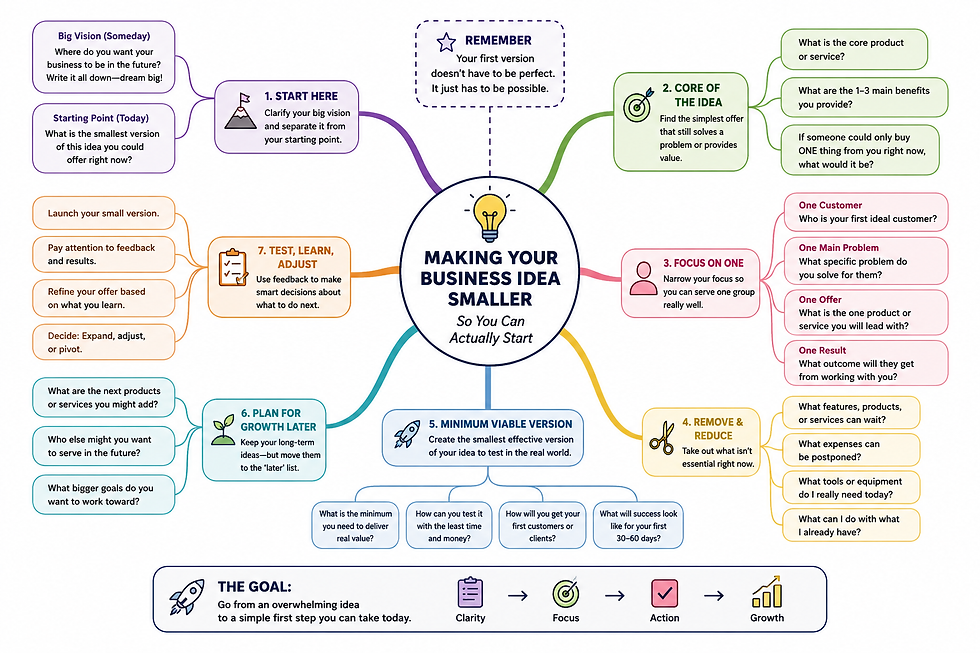
One of the most effective ways to reduce startup costs is to reduce the size of the initial business.
Ask:
What is the smallest version of this idea I could actually sell?
If you want to start a party rental company, perhaps you begin with one rental package.
If you want to sell printable products, start with three strong products instead of creating an entire store.
If you want to become a consultant, begin with one clearly defined service.
If you want to sell handmade products, start with a small collection rather than dozens of variations.
The goal is not to make your business look tiny.
The goal is to determine whether someone is willing to pay for what you are offering before spending heavily to expand it.
If your business idea feels too big or expensive to launch, How to Make Your Business Idea Smaller So You Can Actually Start can help you narrow it down to a simpler version you can test first.
2. Create a Dedicated Business Savings Fund
Bootstrapping becomes much easier when business expenses are planned instead of repeatedly coming out of your everyday spending money.
Create a specific savings goal for the business.
For example, if you believe you need $1,500 to test an idea, break the amount into smaller targets.
You might decide to save:
$25 a week
$50 a week
A percentage of every paycheck
Income from a temporary side hustle
Money earned from selling unused items
A defined savings target can make startup costs feel much more manageable.
If you need a structured way to begin, read How a Savings Challenge Can Help You Save Money to Start a Business. A short-term savings challenge can help you build an initial business fund before you begin purchasing supplies or equipment.
3. Use a Side Hustle to Fund the Business You Really Want
Your first income stream does not necessarily need to be your ultimate business.
Sometimes one small source of income can finance another.
For example, you might:
Freelance while developing digital products
Pet sit while saving for business equipment
Sell a service while developing a product line
Offer local work while building an online business
Sell printables while saving for physical inventory
This is essentially using one income stream to help finance another.
For more examples of how multiple income streams can work together, see 10 Side Hustle Stack Examples.
A side hustle stack can be especially useful when several related services use the same skills, customers, or equipment.
4. Use What You Already Own
Before creating a business shopping list, create an inventory of what you already have.
Consider:
Computer
Smartphone
Printer
Craft equipment
Tools
Camera
Storage space
Vehicle
Office supplies
Software
Furniture
You may already own enough to test your first offer.
Someone starting a mobile craft party business may already own cutting machines, crafting tools, storage bins, and a printer.
Someone starting freelance services may already have almost everything necessary to begin.
Do not purchase a newer version of something simply because it feels more professional.
Upgrade when your current equipment actually limits the business.
5. Sell a Service Before Buying Lots of Products
Service businesses can often be easier to bootstrap because you are primarily selling your time, knowledge, or skills.
Examples include:
Freelance writing
Virtual assistance
Social media services
Pet sitting
Dog walking
Party planning
Organizing
Consulting
Tutoring
Photography
Mobile craft parties
Event setup
A service can also become a way to fund a future product business.
For example, someone who eventually wants an event rental company might begin with party setup services.
As revenue comes in, reusable rental inventory can be purchased gradually.
6. Avoid Large Inventory Purchases Until You Know What Sells
Inventory can consume a bootstrapped business's money very quickly.
Instead of buying large quantities because the unit price is cheaper, consider whether you actually know customers want the product.
When possible:
Start with small quantities
Use made-to-order products
Take preorders when appropriate
Offer a limited collection
Use print-on-demand
Sell digital products
Test products at small quantities before buying wholesale
A slightly higher cost per item can sometimes be preferable to having hundreds of dollars tied up in products that do not sell.
7. Choose Digital Products When They Fit the Business
Digital products are not appropriate for every business, but they can be extremely bootstrap-friendly when they make sense.
Examples include:
Printable planners
Party printables
Worksheets
Templates
Journals
Checklists
Guides
Digital invitations
Business tools
Activity sheets
You create the product once and can potentially sell the same file repeatedly.
There is no physical inventory to store, and there are no individual products to package and ship.
Digital products can also complement a service business.
For example, a children's party planner could sell printable party games, or a consultant could create worksheets based on questions clients frequently ask.
8. Reinvest Early Revenue Instead of Immediately Taking It Out
Your first $100 in revenue may not feel significant.
But in a bootstrapped business, early revenue can become your expansion fund.
Imagine you begin a service using equipment you already own.
You earn your first $300.
Instead of immediately spending that money personally, you might use part of it for:
Better equipment
Additional supplies
Packaging
A website upgrade
Insurance
A new product
Marketing materials
Then the new investment helps you generate additional revenue.
This creates a simple cycle:
Start small → make sales → reinvest → improve → make more sales.
9. Keep Your Fixed Monthly Expenses Low
Small recurring expenses can quietly turn into a substantial monthly business bill.
A $10 subscription does not seem significant.
Neither does a $15 tool.
Or another $20 platform.
Soon, you might be paying for ten programs before the business has enough revenue to support them.
Before adding a recurring expense, ask:
Do I need this right now?
Is there a free or lower-cost alternative?
Will this save enough time to justify the expense?
Is the business generating enough income to comfortably pay for it?
Bootstrapping is not about refusing to pay for useful tools.
It is about avoiding unnecessary fixed costs before the business has reliable revenue.
10. Learn the Basic Skills You Can Reasonably Handle Yourself
Some tasks should be handled by qualified professionals.
But others can be learned well enough for the early stages of a small business.
Depending on your abilities, you may initially handle:
Basic website updates
Product photography
Pinterest graphics
Simple social media posts
Email newsletters
Product descriptions
Basic bookkeeping organization
Packaging
Customer service
You do not have to become an expert in everything.
You only need to determine which jobs are reasonable to handle yourself and which ones justify paying someone else.
As revenue grows, outsourcing the tasks that consume too much time may become one of your best investments.
11. Focus on Low-Cost Marketing First
You do not necessarily need a large advertising budget to find your first customers.
Depending on the business, low-cost marketing might include:
Pinterest
Instagram
TikTok
YouTube
LinkedIn
Local Facebook groups where business promotion is permitted
Google Business Profile for eligible local businesses
Networking
Referral programs
Email marketing
Search-friendly blog content
The best platform depends on where your potential customers are actually looking.
A local party rental company and an online business consultant probably should not have identical marketing strategies.
Choose one or two channels you can consistently use before feeling pressure to be everywhere.
12. Borrow, Rent, or Buy Used When It Makes Sense
Not everything has to be purchased new.
Depending on the type of business, consider:
Used furniture
Used shelving
Refurbished electronics
Used tools
Secondhand craft equipment
Rental equipment
Shared workspace
Borrowing equipment for an initial test
Be more cautious with equipment where safety, reliability, sanitation, warranties, or regulations are particularly important.
The cheapest purchase is not always the best bootstrap decision.
The objective is to spend wisely, not simply spend as little as possible.
13. Ask Customers to Help Guide Your Next
Investment
You do not have to guess what your business needs next.
Customers often tell you.
Imagine you start a mobile craft party business with three projects.
Over several months, parents repeatedly ask whether you also offer bracelet-making parties.
That is valuable information.
Instead of buying supplies for ten activities you hope customers will want, you can expand based on what customers have already requested.
Pay attention to:
Questions customers repeatedly ask
Products they request
Services they wish you offered
Items frequently purchased together
Reasons people decide not to buy
Let demand help determine where your limited startup dollars go.
14. Research Grants—but Do Not Build Your Entire Plan Around Receiving One
Business grants can be worth researching because, unlike loans, legitimate grant awards generally do not need to be repaid when their conditions are met.
However, grants can be competitive, eligibility requirements vary, and funding is never guaranteed.
That means a grant can be part of a funding strategy without becoming the only way your business can move forward.
You can explore current possibilities in Grants for 2026: Small Business Grants and Funding Opportunities.
While applying, continue looking for ways to make the initial version of your business affordable enough to begin without depending on an award.
15. Know What Is Worth Spending Money On
Bootstrapping should not mean avoiding every expense.
Some expenses protect the business or enable you to operate properly.
Depending on your business, those might include:
Required licenses and permits
Appropriate insurance
Safe equipment
Professional legal or tax advice when needed
Quality materials for your core product
Secure payment processing
Tools necessary to perform your service properly
There is an important difference between being frugal and cutting corners.
Save money on things customers do not care about.
Do not save money by ignoring safety, legal requirements, or the quality of the thing customers are actually paying you for.
Bootstrapping Strategies at a Glance
Bootstrapping Strategy | Upfront Cost | Best For | Main Benefit | Watch Out For |
Start with one offer | Very low | Almost any business | Tests demand before expansion | Adding too many options too quickly |
Business savings challenge | Low | Future business owners | Creates a dedicated startup fund | Spending the fund on nonessential items |
Side hustle funding | Low | People who need startup capital | Generates money without business debt | Taking on too much at once |
Use existing equipment | Very low | Service and creative businesses | Reduces initial purchases | Upgrading before necessary |
Start with services | Low | Skill-based businesses | Can generate revenue quickly | Trading all your time for money |
Small inventory batches | Low to moderate | Product businesses | Reduces unsold stock | Higher per-unit costs |
Digital products | Low | Online and creative businesses | No physical inventory | Requires customer demand and marketing |
Reinvest early revenue | Self-funded | Growing businesses | Lets customers help fund growth | Taking on expenses faster than sales grow |
Free/low-cost marketing | Low | Most small businesses | Preserves startup cash | Trying too many platforms |
Buy used or rent | Low to moderate | Equipment-based businesses | Lowers initial equipment costs | Quality and safety concerns |
Customer-led expansion | Low | Existing small businesses | Reduces guessing about what to add | Trying to fulfill every individual request |
Business grants | Application dependent | Eligible businesses | Potential outside funding without traditional debt | Competitive and never guaranteed |
What Should You Spend Money on First?
If your budget is limited, prioritize spending that allows you to actually make a sale.
Ask:
What must exist for someone to pay me?
For a dog-walking business, that may be insurance and basic administrative expenses.
For a mobile craft party business, it might be enough supplies to serve the first eight children.
For an online printable shop, it might be design software and marketplace fees.
For a rental business, it could be one high-quality rental package and the equipment necessary to transport and maintain it safely.
Your logo probably does not need to be perfect.
Your office probably does not need to be beautiful.
Your website probably does not need 30 pages.
Your first priority is creating something customers can purchase.
An Example of Bootstrapping a Business From $500
Suppose you have saved $500 and want to start a mobile children's craft party business.
Instead of trying to create a full mobile craft studio, you could divide your initial budget around one sellable package.
Your first investments might include:
Supplies for a limited number of parties
Table coverings and reusable setup materials
Storage containers
Basic marketing materials
Necessary business registration or insurance expenses
A small emergency supply fund
You could begin with three craft choices rather than 20.
After booking several parties, part of the revenue could fund additional projects.
Later, you might add DIY craft kits.
Eventually, you might add rentals or additional party services.
The first $500 does not need to build the finished company.
It only needs to help build the first version that can generate revenue.
Bootstrapping Does Not Mean You Have to Do Everything Alone
One downside of bootstrapping is the temptation to believe you should never pay for help.
That can eventually become expensive in a different way.
You might spend 20 hours trying to solve something a professional could complete in two.
The goal should be to protect your limited cash while recognizing when professional expertise matters.
Consider outsourcing when:
You are dealing with something legally or financially important
You lack the qualifications to perform the task safely
A task consistently prevents you from doing revenue-generating work
Paying for help will clearly save more time or money than doing it yourself
Bootstrapping is about resourcefulness—not refusing to invest.
Should You Bootstrap or Look for Funding?
You do not necessarily have to choose one forever.
You might bootstrap the first stage of the business and look for additional funding later.
For example:
Bootstrap first when:
You can test the idea inexpensively
You already have many of the necessary skills or tools
You want to maintain control over how quickly you grow
The business can begin generating revenue without a huge investment
Explore additional funding when:
Essential equipment is expensive
You need a commercial location
Inventory requirements are substantial
Demand has been proven but cash is limiting growth
A legitimate grant opportunity closely matches your business
If outside funding interests you, start with Grants for 2026 while also exploring ways to reduce the amount of money you need in the first place.
Use a Side Hustle Stack to Bootstrap Gradually
Another approach is to create several related income streams instead of waiting for one large business idea to generate all of your income.
For example, someone interested in pet services might combine:
Dog walking
Pet sitting
Pet photography
Someone interested in design could combine:
Freelance graphic design
Printable products
Templates
Someone interested in children's parties could combine:
Mobile craft parties
DIY craft kits
Printable party activities
Each income stream can support the others.
Your service may generate faster income while your digital products take longer to build.
Your digital products may later provide sales that do not require you to personally attend an appointment.
For more ideas, see 10 Side Hustle Stack Examples.
Create a Bootstrap Fund Before You Start
If you are still in the planning stage, you have an advantage: you can save specifically for the business before you need the money.
Set an initial target.
It might be:
$250
$500
$1,000
or whatever amount makes sense for the smallest testable version of your business.
Then create a plan for reaching it.
That might involve automatic weekly transfers, a temporary spending challenge, selling unused belongings, or putting side hustle income directly into your business account.
Read How a Savings Challenge Can Help You Save Money to Start a Business for ideas on turning a large startup goal into smaller savings targets.
Frequently Asked Questions About Bootstrapping a Small Business
Can you really start a business with very little money?
Some businesses can be tested with relatively little money, especially service businesses and certain digital businesses.
Other businesses require significant spending on equipment, licensing, inventory, facilities, or insurance.
Instead of asking whether a business can be started for a specific tiny amount, determine the minimum amount needed to deliver one legitimate, safe, sellable version of your offer.
Is bootstrapping the same as starting a business for free?
No.
A bootstrapped business may still require money.
Bootstrapping generally means relying primarily on your own resources and business revenue rather than depending heavily on outside investors or financing.
What is the best type of business to bootstrap?
Businesses with low fixed expenses and relatively small initial equipment requirements are often easier to bootstrap.
Examples can include:
Freelance services
Consulting
Pet services
Local service businesses
Digital products
Printables
Certain handmade businesses
Mobile party services
A business requiring expensive commercial property, specialized equipment, or substantial inventory may be harder to bootstrap.
How do I fund a business if I do not have savings?
You may need to create the startup fund before launching.
Possible approaches include:
Starting a side hustle
Saving a portion of employment income
Completing a savings challenge
Selling unused belongings
Starting a smaller service that requires less capital
Researching legitimate grants for which you qualify
Avoid assuming you need to launch immediately. Spending several months building a startup fund can be part of your business plan.
Should I apply for a small business grant?
It can make sense to apply when you find a legitimate opportunity for which your business is eligible.
However, do not assume an application will result in funding.
Keep building a plan that can move forward even if you do not receive the grant.
See Grants for 2026 for additional opportunities and information.
Should I use a credit card to bootstrap a business?
Borrowing adds financial risk because the debt still has to be repaid whether or not the business succeeds.
Before using debt to fund a new idea, carefully consider your ability to repay it independently of projected future business income and whether the expense is truly essential.
Whenever possible, testing the business at a smaller scale can reduce the amount you need to finance.
When should I stop bootstrapping and invest more money?
Consider increasing your investment when you have evidence that spending more solves a genuine business constraint.
For example:
You are regularly turning away customers because you lack capacity
A product consistently sells out
Better equipment would materially increase production
Customers repeatedly request a related service
Outsourcing would free significant time for revenue-generating work
Growth should ideally respond to actual demand rather than assumptions about what a “real business” is supposed to look like.
Final Thoughts: Let the Business Earn the Right to Grow
Bootstrapping a small business is not about seeing how little money you can possibly spend.
It is about putting your limited resources where they have the greatest chance of producing a result.
Start with one offer.
Use what you already have.
Save specifically for the expenses that matter.
Look for ways to generate income before expanding.
Reinvest when it makes sense.
And allow customers—not your initial wish list—to help determine what the business needs next.
You may eventually have the larger website, bigger product collection, professional equipment, employees, studio, or rental inventory you imagined.
You just do not have to purchase all of it before you make your first sale.


Comments